Before you order
What we can and cannot cut
Most of what people want engraved is entirely fine. A small set of things are not ours to reproduce, and we would rather you knew which before you configured a piece around one of them.
This page is the same list the studio and the review bench work from.
Version 2026-08-12 · PRIVATE JEWELLER LIMITED · Governing law: England and Wales
What we can cut
- Names, initials and monograms — Including the names of children and family members.
- Dates — Any format. Roman numerals are available in the Roman letterform.
- Coordinates — Decimal degrees or degrees, minutes and seconds.
- Short phrases and lines of verse — Within the character limit for the face you have chosen.
- Your own handwriting — Uploaded as a photograph or scan and traced. It must be your writing, or writing you have permission to use.
- A fingerprint or palm print — Uploaded as an image, with explicit consent, used only as artwork for the piece.
- An audio waveform — Rendered from a clip you upload. The audio file is deleted as soon as the drawing exists.
- Simple geometry and symbols — Lines, arcs, dots, stars, hearts, arrows, chemical or musical notation.
- Your own artwork — Line drawings you hold the rights to, subject to review for whether they can be cut at size.
Character limits depend on the blank, the face, the method and the character height. The studio works them out live and will not let you exceed them.
What we refuse
- Registered trade marks and brand logos
Including car makers, fashion houses, technology companies and sports brands. We refuse these whether or not the piece is for personal use. - Football club crests and other sports club badges
These are registered marks and are licensed. We are not a licensee. - University, school and college arms
Almost always granted arms or registered marks belonging to the institution. - Military, police and emergency service insignia
Restricted by the bodies that own them, and in some cases by statute. - Currency, official seals and documents
Banknote artwork, government seals, passports and identity documents. - Family coats of arms and heraldic devices
Arms are personal property granted by the Crown through the College of Arms in England and Wales, or the Court of the Lord Lyon in Scotland. We do not cut them, including arms you believe belong to your surname. - Photographs or likenesses of other people
A print or a signature is a keepsake; someone else's face is their likeness, not yours to reproduce. - Copyright-protected artwork, lyrics beyond a short quotation, and licensed typefaces
Character designs, illustrations and complete song lyrics need the rights holder's permission. Typeface outlines are themselves protected. - Anything unlawful, threatening or abusive
Including content targeting a person or group, and content that would harass its recipient.
Why we refuse it
Three separate reasons, and they are not interchangeable.
Someone else owns the mark
Trade marks, club crests and institutional arms belong to the organisations that registered them. Reproducing them on goods is exactly what registration is designed to control, and personal use is not the exemption people assume it is. We are not a licensee of any brand, club or university.
Arms are granted, not inherited by surname
In England and Wales a coat of arms is personal property granted by the Crown through the College of Arms; in Scotland it is the Court of the Lord Lyon. A surname does not carry arms with it, and the pleasant-looking crest sold online under your family name is, in almost every case, not yours to wear. Engraving one is the reason signet rings have a complicated reputation. We cut initials and geometry instead.
It is someone else's likeness or someone else's work
A print or a signature from your own family is a keepsake. A photograph of a person who has not agreed to it is their likeness. Illustrations, characters, complete song lyrics and typeface outlines belong to whoever made them.
Human review before anything is cut
Uploads are reviewed by a person before anything reaches the bench. If we cannot use what you have sent, we tell you why, offer to work with you on an alternative, and refund the piece in full if you would rather not proceed.
Uploads sit in a review queue with the status pending until a person marks them approved. Nothing enters the production queue while an upload is pending, and nothing is cut from an upload that has been rejected. Typed text is checked at the same point, against this page.
If we turn your artwork down
- We email you the reason, from the list on this page, within one working day of the review.
- You can send different artwork, switch to typed text, or ask us to cancel the piece.
- If you would rather not proceed, we refund that piece in full. This is separate from the 24-hour cancellation window on your order — a rejected upload is always refundable, whenever the review happens.
If the rejection was our misunderstanding rather than a rights problem, say so and a person will look at it again.
Upload requirements
Handwriting
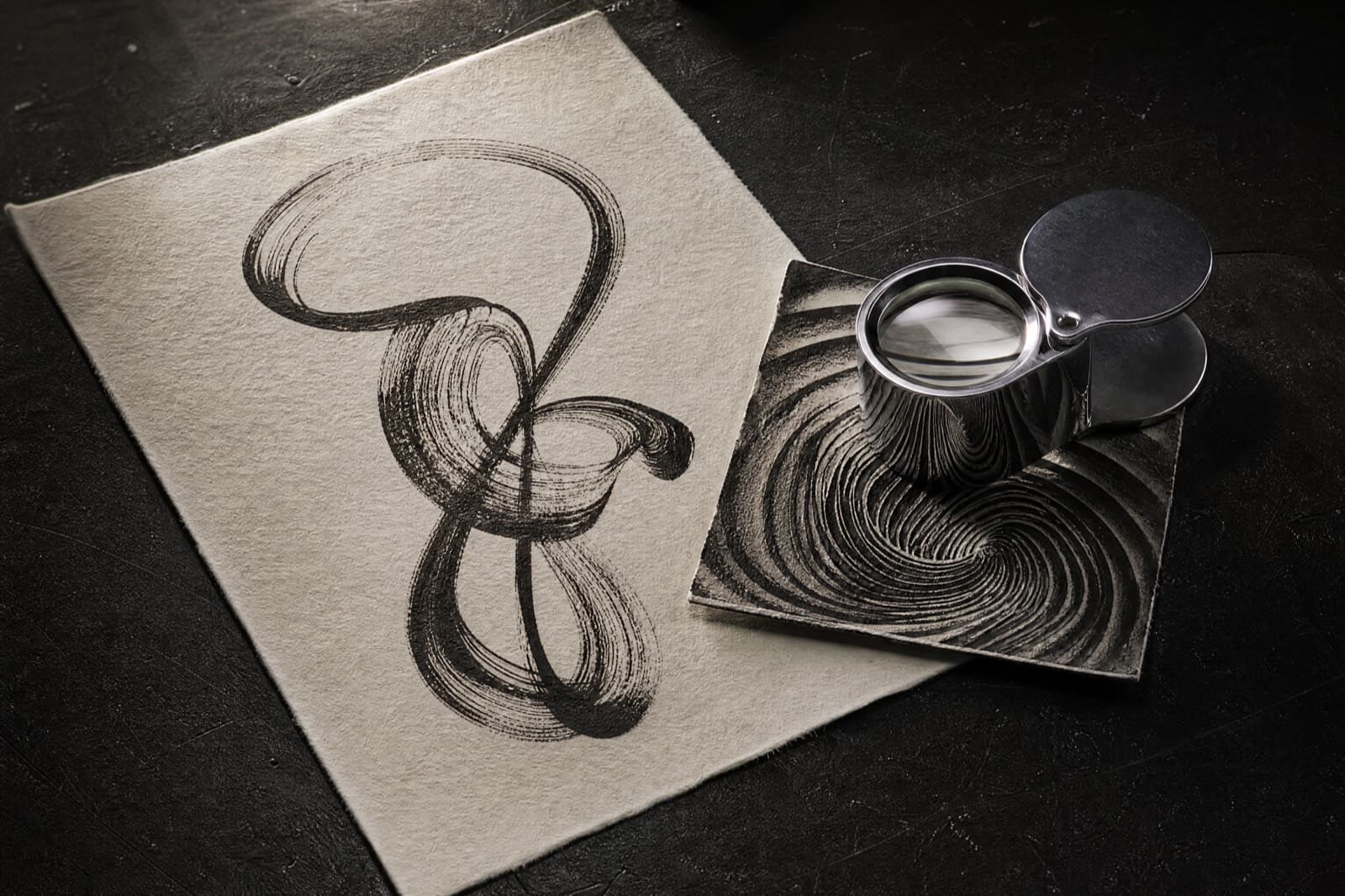
- Photograph or scan on white paper, JPEG or PNG, 1200 px or more on the long edge.
- Dark ink. Pencil and thin ballpoint frequently fail the trace and get rejected.
- Flat lighting, no shadow across the stroke, no perspective distortion.
Prints
- An ink impression on paper, photographed flat, or a scan at 600 dpi or more.
- Even pressure. A heavy print fills the ridges in; a light one loses them. Two or three attempts is normal.
- Explicit consent is required before we will accept the file. See privacy and data for exactly what we do and do not do with it.
Audio
- Up to 8 seconds, WAV or MP3, under 8 MB.
- We render the waveform as a drawing and delete the audio file immediately afterwards. It is not held for the artwork retention period.
How we hold uploads
- Private storage, random filenames, access only through short-lived signed links.
- Location and camera metadata stripped on arrival.
- Deleted 90 days after the order completes, unless you ask us to delete it sooner.
- Never used for marketing, published examples or training any model, unless you separately and specifically agree — and that is off by default.