Before you order
Hallmarking is criminal law, not a courtesy
In the UK it is a criminal offence to describe an unhallmarked article as gold, silver, platinum or palladium in the course of trade, unless it is under the exemption weight for that metal.
A made-to-order piece has no weight until you have configured it. So we estimate it live, decide about submission for you, and put the cost and the days on the docket.
Version 2026-08-12 · PRIVATE JEWELLER LIMITED · Governing law: England and Wales
What a hallmark actually is
A UK hallmark is a set of tiny marks struck into the metal by one of the four assay offices — London, Birmingham, Sheffield or Edinburgh — after they have independently tested the alloy. It is not a maker's decoration. It is a third party confirming what the metal is, and it has been a legal requirement in some form since 1300.
The compulsory part of the mark is three things:
- The sponsor's mark — the registered initials of whoever submitted the article.
- The fineness mark — the metal and its purity in parts per thousand: 925 for sterling silver, 375 for 9ct gold, 750 for 18ct gold, 950 for platinum.
- The assay office mark — which office tested it.
A date letter and the traditional pictorial fineness symbols are optional additions. We do not add marks of our own beyond the required set.
Dealer's Notice
Information on UK hallmarks
United Kingdom hallmarks consist of three compulsory symbols: the sponsor's or maker's mark, the metal and fineness mark, and the assay office mark. Additional optional marks may also be applied, including the traditional fineness symbol and the date letter.
Fineness marks — Silver 800, 925, 958, 999. Gold 375 (9ct), 585 (14ct), 750 (18ct), 916 (22ct), 990, 999. Platinum 850, 900, 950, 999. Palladium 500, 950, 999.
Exemption weights — Silver under 7.78 g, gold under 1 g, palladium under 1 g and platinum under 0.5 g are exempt from hallmarking.
This notice is displayed as required of dealers in articles of precious metal. It is also displayed at our registered address.
Exemption weights
| Metal | Exempt below | Stocked by us | What that means in practice |
|---|---|---|---|
| Silver | 7.78 g | Yes | Most small discs, bars and slim bands stay under it. Signets, wide bands, bangles and cufflinks do not. |
| Gold | 1 g | Yes | Almost every gold piece we make is over 1 g, so expect submission as the normal case. |
| Palladium | 1 g | Not stocked | Listed for completeness; we do not work in palladium. |
| Platinum | 0.5 g | Yes | 0.5 g is lower than any piece we make. Platinum is always submitted. |
The figures are set by statute, not by us, and they apply per article. A pair of cufflinks is two articles — but sold together their combined weight is over the silver exemption, so we submit and strike each link rather than argue the point.
Why this is harder for made-to-order work
A shop selling finished stock knows the weight of everything on the shelf. We do not know the weight of your piece until you have chosen the blank, the metal and the size — a ring three sizes larger uses measurably more metal, and gold is half again as dense as silver. The same blank can sit either side of the line depending on those choices.
So the studio does three things, in this order:
- Estimates the finished weight from the blank, the metal density and the size you picked, and shows it on the docket as it changes.
- Compares it against the exemption weight for that metal and, when it is over, sets the piece to be submitted. This is not a suggestion you can dismiss: the order cannot be placed until you have confirmed the submission, and the server checks it again before the order is accepted.
- Adds the cost and the time — £22 per article and three working days — to the quotation and the lead time before you pay.
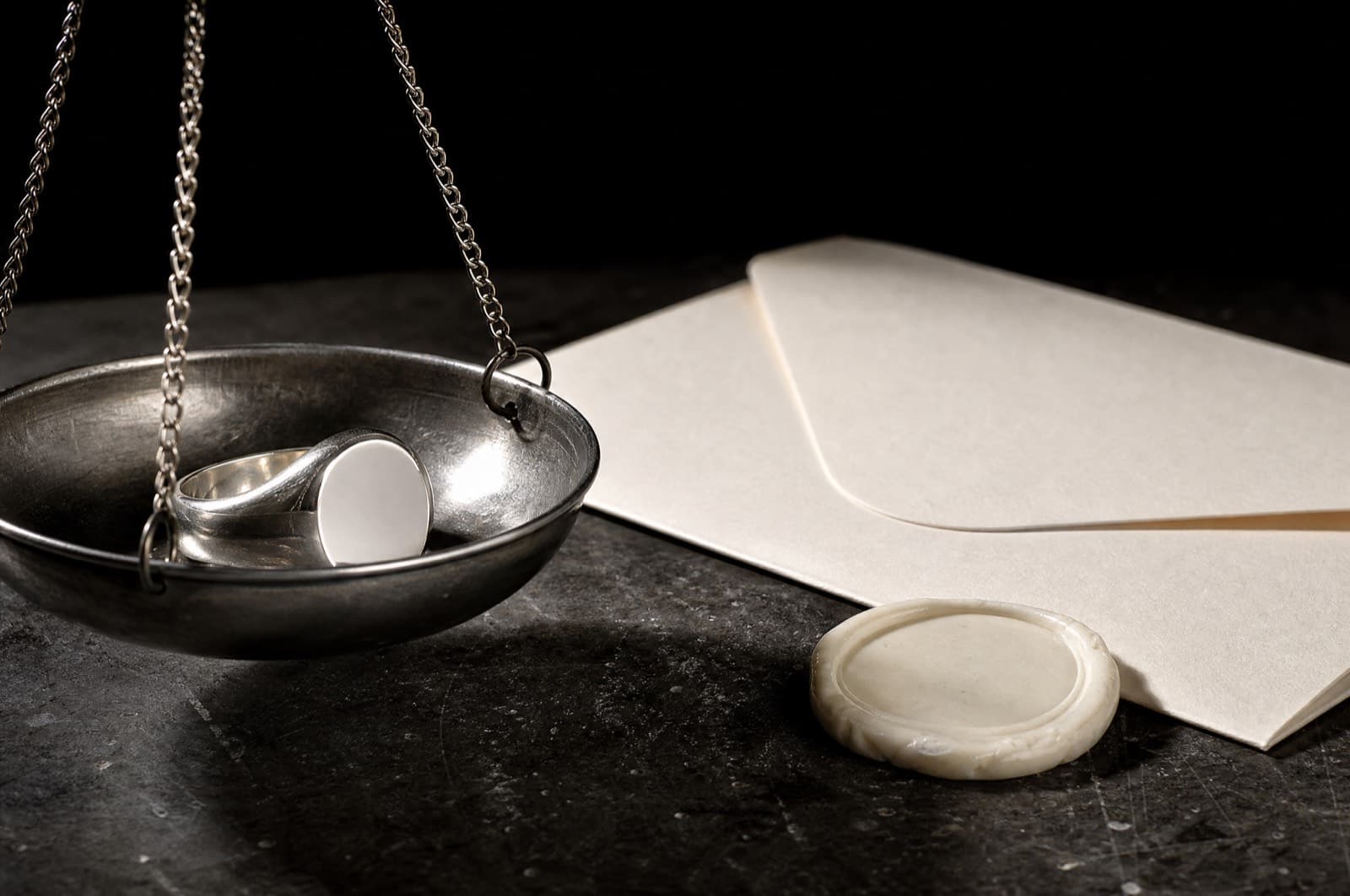
The estimate is an estimate. If the finished piece comes off the bench materially heavier than we projected and crosses the line when we said it would not, we submit it, we absorb the fee, and we tell you about the extra days.
The submission process, and what it does to the lead time
- The blank is finished and weighed.
- Where the piece is above the exemption weight it goes to the assay office before engraving, so the struck mark is in place and we can lay your text out around it.
- The office tests the alloy and strikes the compulsory marks.
- It comes back to the bench, and only then is your content cut.
- Final polish, check, pack.
Three working days is our normal allowance for that round trip. Assay offices have queues of their own, and they are closed on bank holidays; where a queue is longer than usual we email you rather than let the date drift silently. We do not promise a delivery date on a piece that has to be submitted.
Engraving keeps clear of the mark
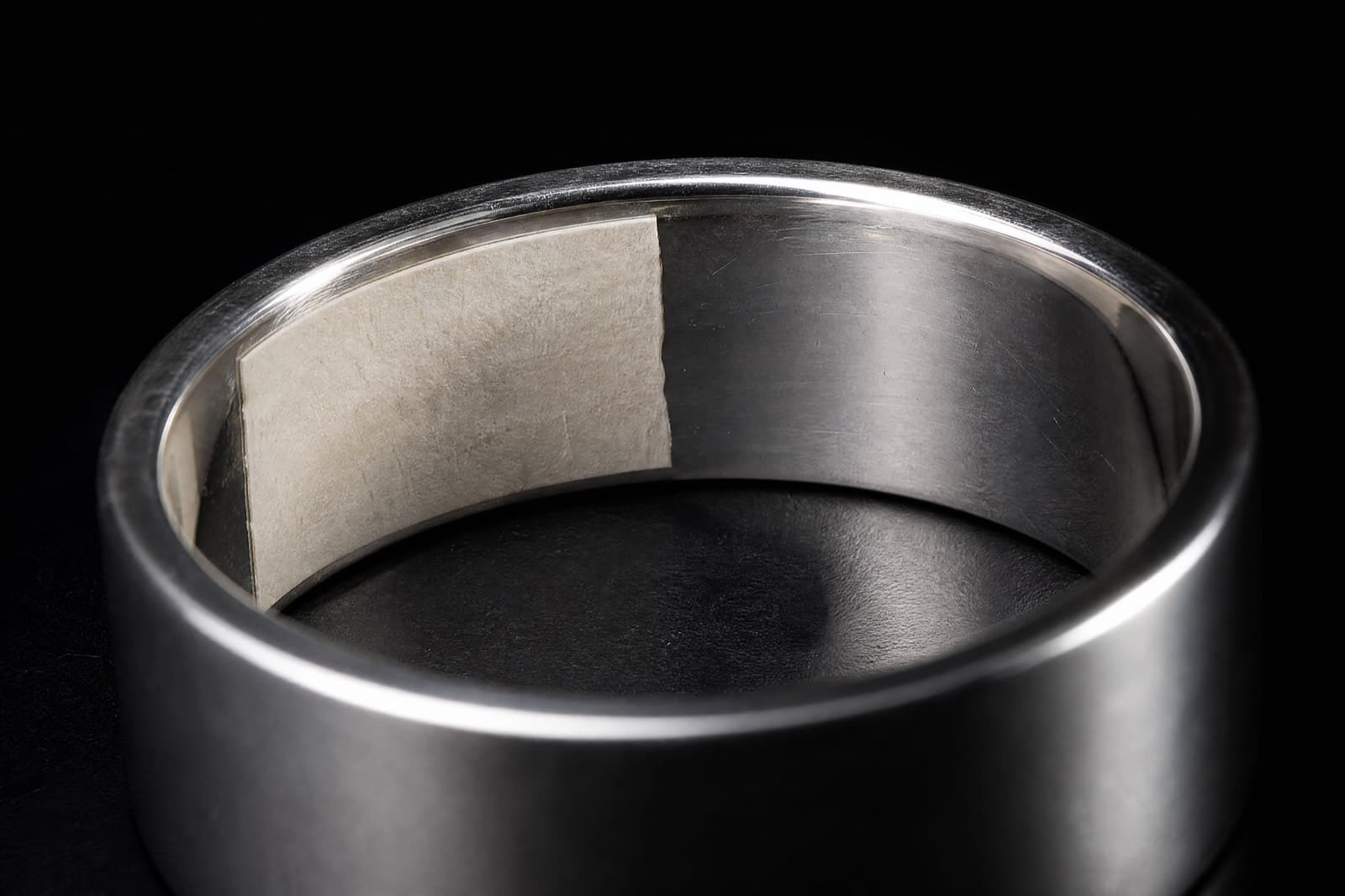
A hallmark needs somewhere to go, and on a ring that somewhere is the inner wall — the same surface most people want their inscription on. Cutting text through a hallmark damages it, and a damaged hallmark is a serious problem rather than an aesthetic one.
So the reserved area is part of the geometry rather than a note on a drawing. On rings we hold back 8 mm of the inner circumference; on bangles and cuffs, 10 mm. The studio subtracts it from the usable width before it calculates your character limit, hatches it in the preview, and will not let the position controls move your text into it. The bench works from the same coordinates.
That is why a 5 mm band at UK size M gives you 44.5 mm of usable width rather than 52.5 mm. The missing 8 mm is the mark.
Reading the marks on your piece
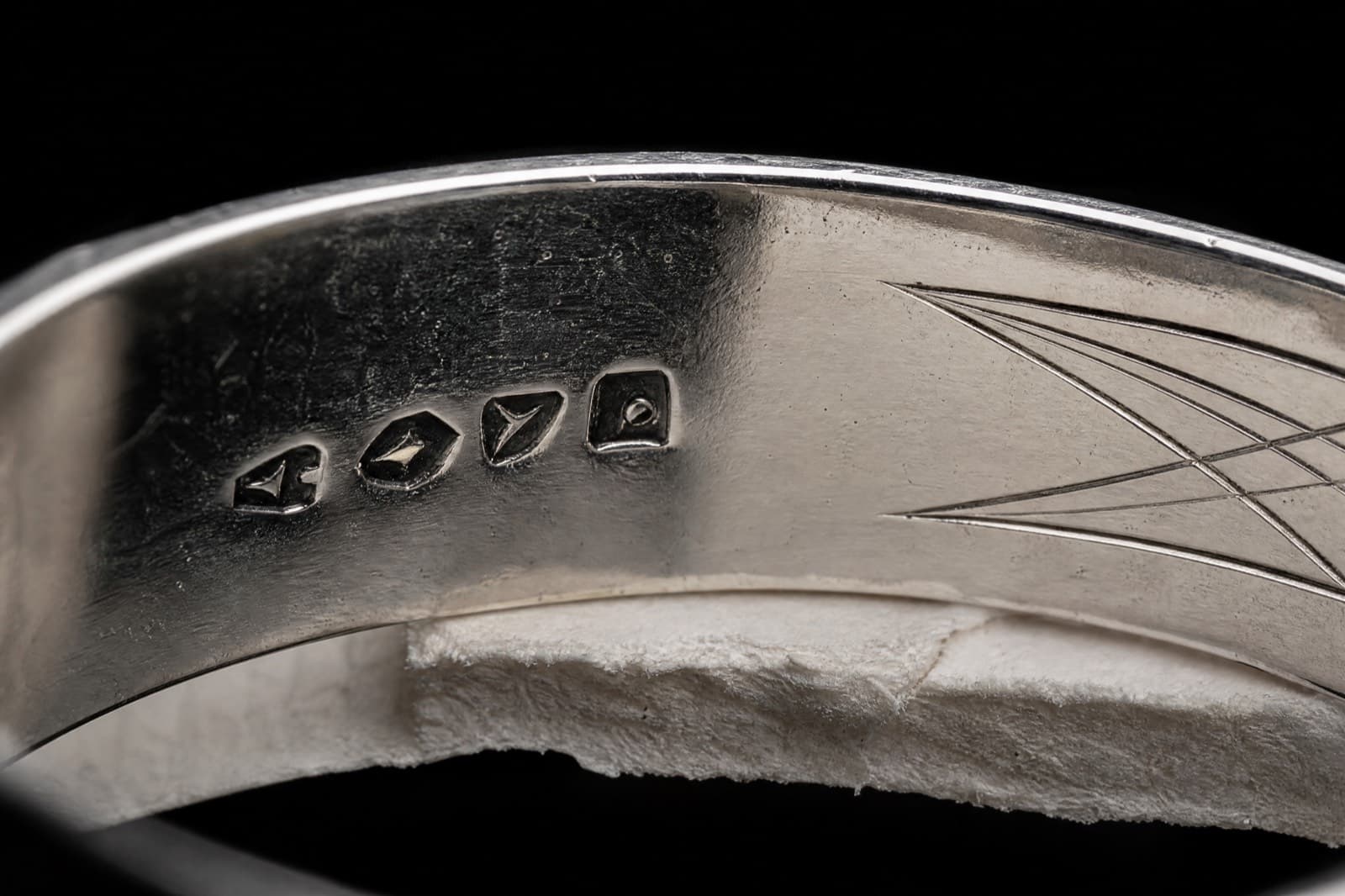
Under a loupe you will find the marks in a row, and they read left to right in the order they were struck: sponsor, fineness, assay office, and a date letter if one was applied. They are small — often under a millimetre — and struck rather than printed, so they sit below the surface and catch the light differently from an engraved line.
If you cannot find them, they are exempt rather than missing: a 15 mm silver disc weighs 1.8 g, comfortably under the 7.78 g threshold, and carrying no hallmark is entirely lawful for a piece that light. The product page and the docket both tell you which case yours is.
If you would like the optional date letter or the traditional fineness symbol added, ask before you order — it is struck at the same time and costs nothing extra, but it cannot be added afterwards without a second submission. Questions go to our contact page.